Dreharbeit
Werkstatt
In Produktion: „Das Zischen der sterbenden Kerze“
In Produktion: „Das Zischen der sterbenden Kerze“
Vom geschriebenen Wort zur digitalen Leinwand
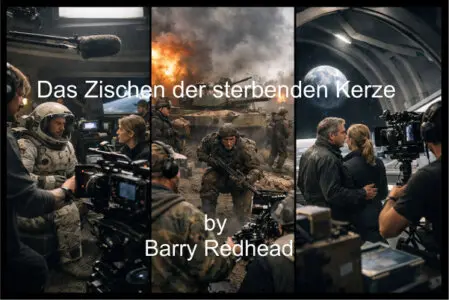
Es ist so weit: Die Vision einer sterbenden Erde und der einsamen Wächter auf dem Mond verlässt das Papier. Aktuell befinden wir uns in der intensiven Vorbereitungsphase, um eine meiner Science-Fiction-Kurzgeschichten „Das Zischen der sterbenden Kerze“ als atmosphärischen Kurzfilm zu realisieren. Wir erschaffen dieses Werk mithilfe modernster digitaler Technik und Avataren, behandeln den Prozess jedoch wie einen klassischen, großen Kino Dreh. Hier ist ein Einblick in den aktuellen Stand der „Dreharbeiten“.
In Production: "The Hiss of the Dying Candle"
From the Written Word to the Digital Screen
The time has come: the vision of a dying Earth and the lonely guardians on the moon is leaping from the page. We are currently in the intensive pre-production phase to bring one of my science-fiction short stories, "The Hiss of the Dying Candle", to life as an atmospheric short film. I am creating this work using state-of-the-art digital technology and avatars, yet we treat the process exactly like a classic, major cinematic production. Here is an insight into the current state of "filming".
The Tech: The Powerhouse Behind the Images
A project this visionary demands brute processing power. To render the oppressive level of detail in Luna-Europa and the devastating battles on Earth smoothly and in the highest quality, a water-cooled high-end PC forms the technical backbone of the production. Equipped with 128 GB of DDR5 RAM and the immense power of the NVIDIA GeForce RTX 5090, we are setting new standards in visual representation:
- Real-time Ray Tracing: Thanks to the 5090 architecture, we simulate light rays in real time. The pale light of the dying Earth refracting through the quartz glass of the lunar dome, and the shadows cast across the cratered landscape, achieve photorealistic depth.
- Particle Simulation: Complex scenes of burning refineries in Eastern Europe – featuring smoke, fire, and splashing oil – are calculated with physical accuracy by the massive array of shader units, ensuring the render pipeline never falters.
- Maximum Texture Sharpness: The vast DDR5 memory allows us to use 4K textures for the lunar station surfaces and digital costumes, making every detail – from moon dust to textile fibres – feel tangible.
- Digital Casting in CC5: We model our protagonists down to the smallest pore. With CC5, we create hyper-realistic avatars whose skin textures and facial expressions reflect the hardships of the lunar station. We are fine-tuning Arthur’s weary eyes and Sarah’s pale complexion to convey the emotional weight of the story.
- Direction and Animation in iClone 8: This is where the actual "shoot" takes place. Through the seamless integration of the RTX 5090 into iClone 8, we can evaluate complex character animations and camera pans directly in the preview with full lighting. Whether it is the subtle trembling of hands or a wistful gaze toward Earth – every movement is precisely choreographed.
- Screenplay: Finalised and divided into storyboards.
- Set Construction: Digital reconstruction of the lunar base 25% complete.
- Casting: Final character development in CC5; initial rehearsals in iClone 8.
- Hardware: High-end workstation (RTX 5090 / 128 GB DDR5 RAM / Water-cooling / 19TB SSDs) fully calibrated.
Casting & Direction: iClone 8 and Character Creator 5
For the "acting", we rely on the cutting edge of digital character development. In our virtual studio, we use Character Creator 5 (CC5) and iClone 8 to bring Arthur and Sarah to life.
The Setting: Luna-Europa Becomes Reality
Our digital designers are currently working around the clock to finish the main set. We are reconstructing the feeling of those 400 souls trapped in their "glass jar". The lighting is guided by the harsh reality of the two-week lunar night – a contrast of deep blacks and the sterile glow of dwindling reserves.
The Plot: A War for the Blood of the World
While silence reigns on the moon, we are simultaneously preparing computer-generated mass scenes for the flashbacks to Earth. The "March of the Desperate", the steel tank-beetles in the mud, and the monstrous heart of the refinery near Rostov – these scenes will become the visual force of the film, powered by the RTX 5090.
Production Status Report
"The Hiss of the Dying Candle" is more than just a film – it is the chronicle of a foretold end and the search for a final spark of warmth in a cooling galaxy. Stay tuned here for exclusive insights into the render pipeline and the first moving images of our digital cast.
About me!
Behind the adaptation of "The Hiss of the Dying Candle" lies a passion for profound science fiction and a fascination with the limits of what is digitally possible. For me, working with avatars is not a substitute for traditional cinema, but its logical evolution. "My goal is to capture the emotional fragility of the human soul in a technocratic, dying world. By using iClone 8 and Character Creator 5, I have absolute creative control over every detail – from the slightest quiver of an eyelid to the monumental destruction of a distant world." The use of my water-cooled high-end workstation with the NVIDIA RTX 5090 is not an end in itself. This technology serves as a brush, allowing me to render light, shadow, and human emotion in a quality that was previously unimaginable. I see myself as a bridge-builder between classic storytelling in the style of Ray Bradbury and the digital revolution of the 21st century.