Music Streamer
TXT engl.
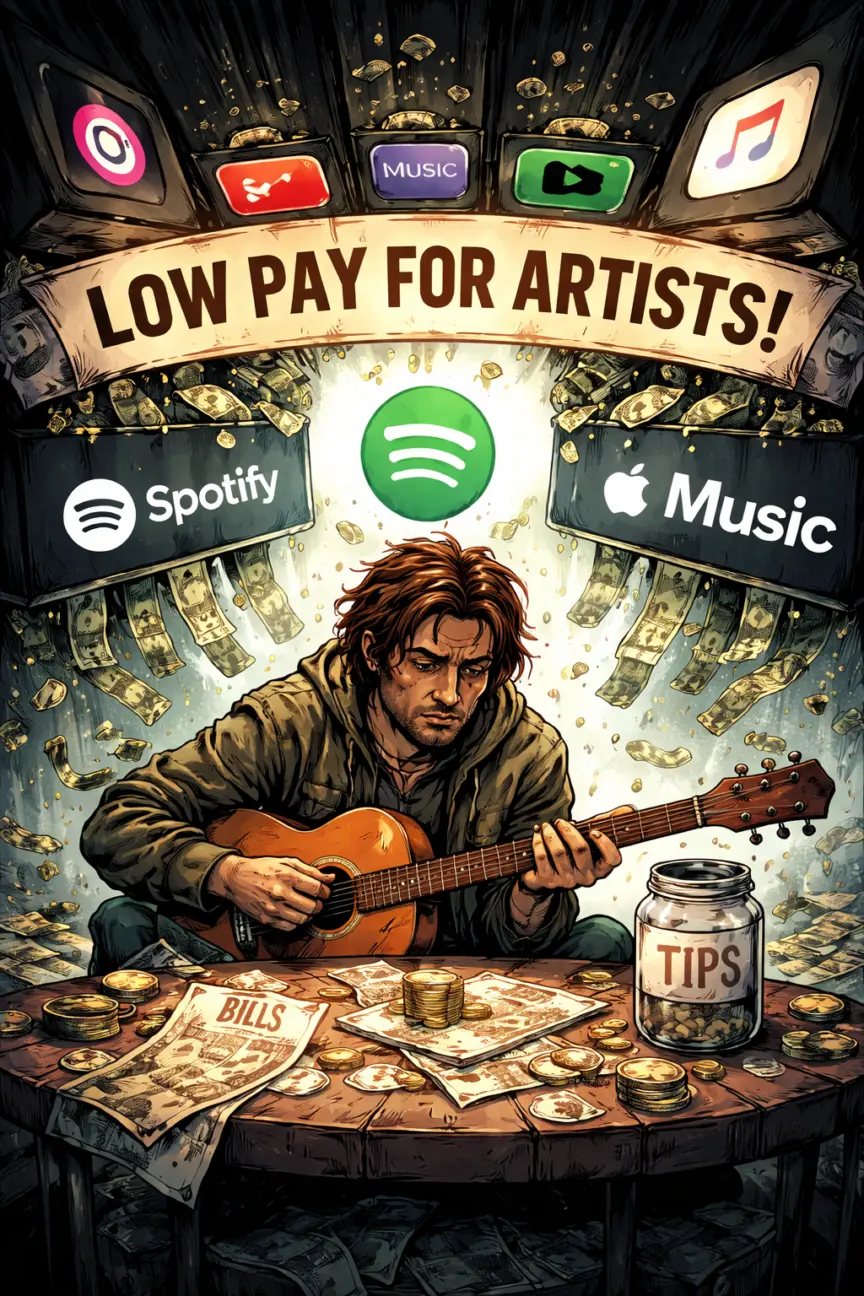
Record Revenues, Tiny Shares: Why Musicians Are Still Paid Unfairly in the Streaming Era!
Streaming has stabilised the music business financially, but it has not made it fairer. In its latest report, Spotify says it paid out more than 11 billion US dollars to the music industry in 2025. At the same time, the company itself makes clear that neither Spotify nor other major streaming platforms operate with a fixed payment per stream. Revenue is distributed according to market share of total streams. The money first goes to rights holders such as labels, publishers or distributors, and only then — depending on the contract — reaches artists and songwriters. This is where the problem begins: high overall payouts do not automatically mean fair incomes for the people who make the music. Particularly controversial is Spotify’s rule, introduced in April 2024, that tracks with fewer than 1,000 streams over the previous twelve months are no longer included in the recorded royalty pool. Officially, the aim is to curb manipulation and reduce micro-payments with little practical value. In reality, however, the rule mainly strengthens songs that already have reach. For niche artists, newcomers and smaller independent acts, this sends a clear signal: anyone who remains below the visibility threshold falls behind more quickly in the payment system. That is a journalistic assessment, but it follows directly from the logic of the system Spotify has described.
The debate is no longer being driven by artists alone. At the beginning of 2024, the European Parliament explicitly stated that revenues in the streaming market are not being distributed fairly and that the majority of authors and performers receive only very low remuneration. It called for more transparent algorithms, fairer distribution models and stronger protection for cultural diversity. In the United Kingdom, the issue has also become political. The government has acknowledged ongoing concerns over low streaming income and, since 2025, has supported new industry principles intended to improve conditions for legacy artists, songwriters and session musicians. That reform is possible can already be seen in early alternative models. In France, Deezer and Sacem introduced an artist-centric remuneration model for publishing rights in 2025. Its purpose is to reward genuine artists with active fan bases more strongly, limit fraud-prone mechanisms and remove functional noise content from the remuneration base. Tracks by artists who reach at least 1,000 monthly streams from 500 different subscribers are given greater weighting. This is not yet a solution for the entire industry, but it is a clear signal: even platforms now recognise that the existing streaming model is no longer sustainable for everyone.
The real conflict, then, is no longer whether streaming saved the music industry. The more important question is whom it supports — and whom it does not. As long as record figures mainly function as industry headlines while many musicians still cannot live from streaming income alone, the criticism remains justified. The problem is not only the size of the payout. It is a system that rewards scale, deepens dependency and still too often promises fairness instead of delivering it.
