Fantasy und Science - Fiction
TXT engl.
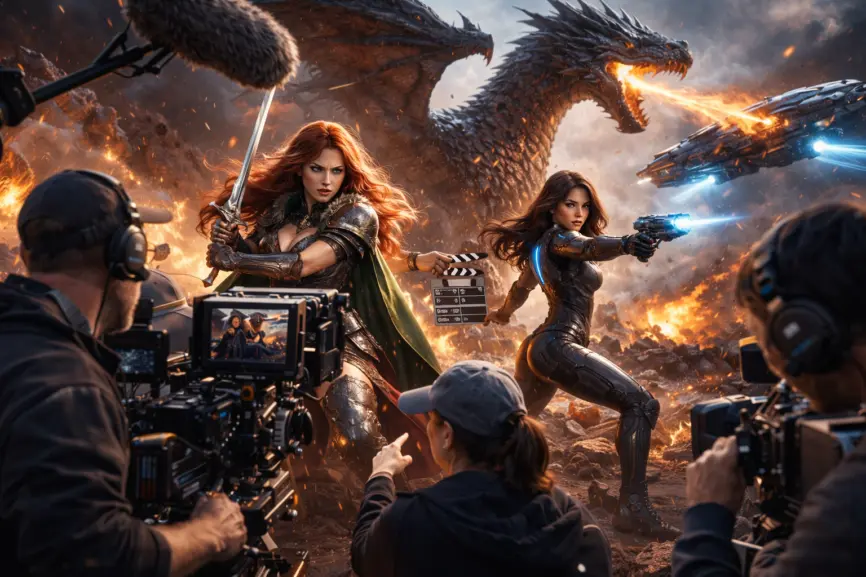
Science Fiction or Fantasy? Two Genres, Two Completely Different Ways of Seeing the World!
Fantasy seduces us with magic, myth, dragons, ancient kingdoms, and destiny. Science fiction looks in a different direction. It asks not what supernatural force rules a world, but what happens to people, societies, and power structures when technology, politics, and social change are pushed forward. That is the key difference: fantasy creates wonder, while science fiction investigates consequences. Fantasy thrives on the impossible. Science fiction works with possibility. It takes what already exists today — artificial intelligence, surveillance, climate crisis, war, shifting political power, biotechnology, space travel — and turns it into believable images of tomorrow. That may also explain why science-fiction film has long been perceived as a more male-coded genre, while fantasy often felt more emotional, mythical, and romantic to many female audiences. That division is no longer as simple as it once seemed, but the cultural image remains strong: science fiction is often associated with systems, conflict, technology, and the future, while fantasy is linked more closely to myth, destiny, magic, and emotion.
At its best, science fiction is far more than futuristic production design. It is a space for thought. It allows filmmakers to project political developments, technological innovations, and social tensions into the future. No one can truly see what tomorrow will look like. But great science fiction can show what it might look like — plausibly, uncomfortably, and often with disturbing closeness to the present. Many great filmmakers built their worlds on exactly that principle. Ridley Scott turned the future in Blade Runner into a dark megacity shaped by corporate power, identity crisis, and technological alienation. Denis Villeneuve uses Dune to explore imperial politics, religion, resource wars, and destiny — somewhere between science fiction and desert mythology. The Wachowskis transformed The Matrix into a philosophical battleground about reality, control, and freedom. And George Lucas, with Star Wars, created a universe full of spaceships and planets that still operates like a mythic tale of empire, rebellion, and fate.
This is where things become especially interesting: some films deliberately merge both genres. Dune is one of the clearest examples, combining futuristic technology, interstellar politics, and ecological systems with ritual, prophecy, sword combat, and near-mystical imagery. Reign of Fire does something similar from the opposite side: a post-apocalyptic future collides with dragon fantasy. Films like these show that science fiction and fantasy are not enemies — they are often two creative energies that can strengthen each other.
Another striking fact is that so much science-fiction cinema is dystopian. The reason is simple: dystopias are more dramatic than perfect worlds. A flawless future creates little conflict. A broken future creates fear, tension, and urgency. Films such as Silent Running prove that point. The future is not presented as paradise, but as warning. Technology, progress, and power are not shown as salvation, but as possible threats to nature, freedom, and humanity. Even franchises like Star Wars and Star Trek never fully become a true “brave new world.” In Star Wars, the galaxy is defined by empire, war, oppression, and rebellion. Star Trek is more hopeful, but even there the story needs crisis, enemies, covert power, ethical dilemmas, and instability. Perhaps that is the real truth of the genre: the future on screen is rarely peaceful, because cinema needs friction.
The difference can be summed up in one sharp line: Fantasy asks what miracles a world can contain. Science fiction asks what future a world can survive.
And that is exactly why science fiction remains so unique: it does not simply show us other worlds — it shows us what our own world might become.
