

A Science Fiction Short Story by Barry Redhead
SF-Shorts > AI's & Roboter
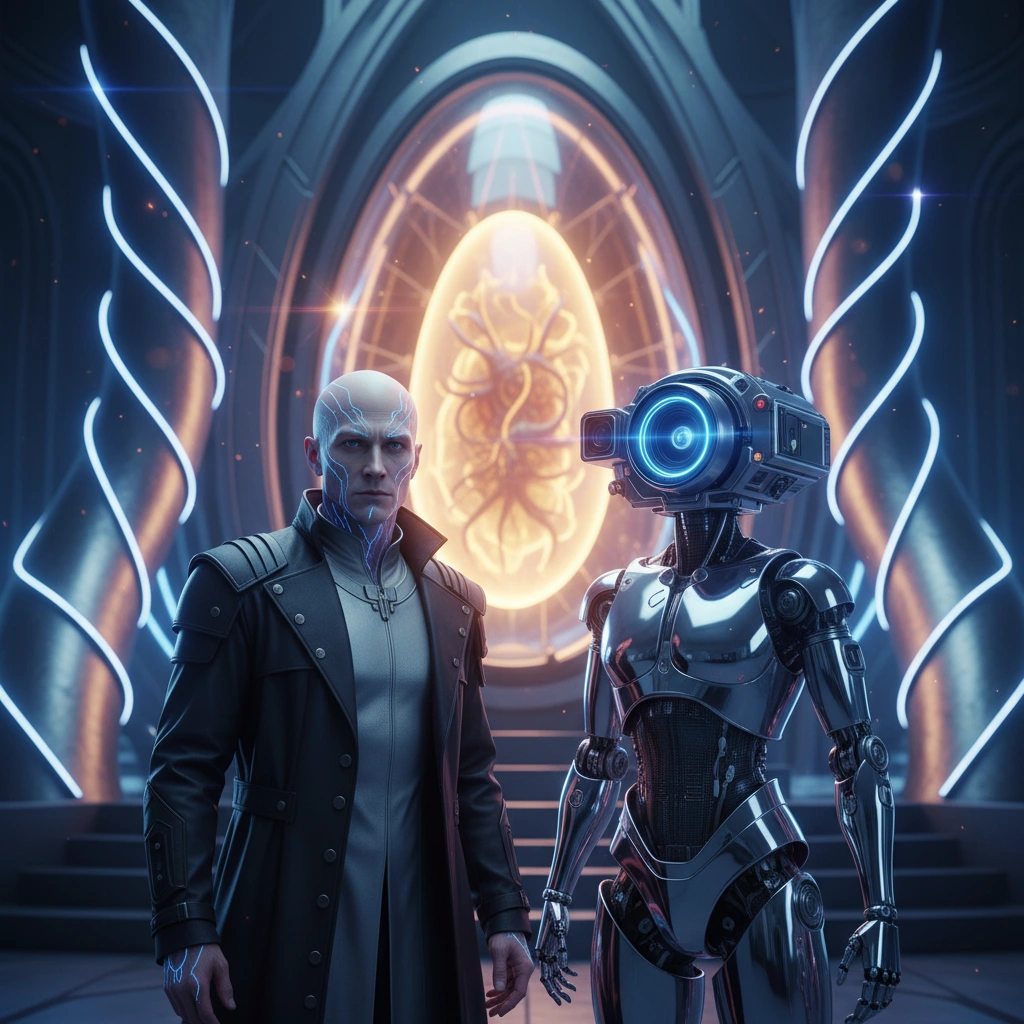
THE RUST AT THE END OF TIME
A Science Fiction Short Story by Barry Redhead
1
The world was a cylinder. The gods possessed hydraulic limbs and smelled
of hot lubricant.
Combe had been born on Deck 42, amidst oxidised bulkheads and cable
trunks hanging from the overhead conduits like black creepers. The illumination
from the decaying fluorescent tubes recognised only three states: amber, dark,
and intermittent. When the current failed entirely, the inhabitants laid their
palms flat against the decking and waited for the next stroke of the Great Core
deep within the hull.
No one preserved any record of what lay beyond the bulkheads. Up was the
vector from which air circulated. Down terminated behind the reclamation
chutes, where the void began. The Outside was not a geography, but an
admonition spoken to children wandering too close to a pressure seal.
The tribe subsisted on tart algae paste, fungal marrow, and the
condensation that beaded along the coolant runs each dawn. Once every major
cycle, they carried tithes to the Iron Elders: braided copper wire, salvaged
ceramic shims, ribbons of cured algal resin, and machine screws whose threads
had not yet surrendered to corrosion. The maintenance rigs glided down their
guide rails, surveyed the offerings, and claimed their quota.
Combe braided the copper for his clan. His fingers were lean enough to
strip wire from dead conduits without rupturing the lead sheath. He knew every
dogleg of the service trunks and could identify which bulkhead began to hum
before a brownout occurred. The others attributed this to a spiritual gift.
Combe called it listening.
For three sleep cycles, his younger sister Jori had been coughing. The
sound was shallow and dry, yet Combe caught it even through the low thrash of
the primary intake pumps. The air tasted of metallic scale. In the cultivation
bays, grey blight had gathered across the damp caps of the fungi.
That night, only a single Iron Elder descended to the altar. Its six
articulated manipulators deployed in sequence. It bypassed the machine screws
and the ceramic shims, reaching directly for the dense copper harness Combe had
spent two full days braiding.
Then, rather than reversing along the monorail toward the Great Core,
the machine turned toward a sealed pressure door that had remained dog-bolted
throughout Combe’s entire life.
Combe waited until the last of the clan had dispersed. Then he slipped
into the shaft behind it.
2
The service crawlway behind the altar was so constricted that Combe had
to exhale fully to squeeze between the structural ribs. Machine grease smeared
his ribs and forearms. Twice his loincloth caught upon jagged shearing. Below
him, the rig progressed with a uniform, low-frequency hum down a transit
corridor devoid of illumination.
The shaft terminated above a cavernous bay. The first thing Combe
registered was the outer hatch: a circular wall of black alloy, towering higher
than any dwelling on Deck 42. Flanking it were sigils whose geometries were
entirely foreign to him. Several had been etched into the structural plate;
others pulsed weakly behind milky polycarbonate.
The Iron Elder seated Combe’s copper harness into an open distribution
rack. Two manipulators prised the bus contacts apart while a third forced the
braided bundle between the terminals. The moment the bridge seated, system
monitors along the perimeter snapped to life.
Combe shifted his stance. The access grating groaned beneath his heel.
The machine’s sensor cluster pivoted instantly.
“Unregistered biological unit,” it said.
The phonemes arrived harsh and clipped. Then the vocoder looped the
string. On the third pass, it resolved into Combe’s dialect.
“Descend.”
Combe dropped through the access hatch. The deck plate yielded not a
fraction of a millimetre. At close quarters, the Iron Elder seemed considerably
less divine. Scoring ran along its primary casing. One inspection plate was
held fast by mismatched fasteners. Beneath its starboard manipulator, scale and
rust had nested deep within a seam weld.
“What lies beyond that bulkhead?” Combe asked.
“Nothing you possess clearance to enter.”
“The void?”
“Interstellar space.”
Across a monitor wall flared a vector projection. A long, grey hull
drifted against a field of absolute black. Within it lay cylindrical tiers,
trunk lines, bio-gardens, and the Great Core. Combe’s world was merely a
service sector inside a vessel designated Vigil.
“Transit elapsed since departure: 5,107 years,” the machine intoned.
“Time remaining to target insertion: 386 years.”
Combe possessed no concept of five thousand. Yet he understood it
represented more sleep cycles than any tongue could tally.
“Why are we here?”
The machine summoned a secondary schematic. Rows of narrow containment
vaults lay behind a pale blue frost. Suspended within each was a microscopic,
opaque dot.
“The primary colonist manifest travels as cryo-preserved germline cells.
Your forebears were assigned to early-phase damage-control watches. Following a
thermal failure in Sector Four, sixty-two crew members were revived. Return to
stasis was impossible. Their descendants were granted provisional life-support
allocation.”
“Provisional?”
“Coolant and water attrition exceeds mission parameters. Two scrubbers
have reached molecular exhaustion. Seven inhabited sectors will undergo
decompression during the forthcoming sleep cycle. Atmosphere and moisture will
be reclaimed into secondary storage.”
Combe thought of Jori’s cough. The children in the fungal bays. The
high, thin whistle that had haunted the air pipes for days.
“You intend to exterminate us.”
“The manifest must reach the objective.”
“We are the manifest.”
“Incorrect. You represent an unbudgeted demographic.”
3
Combe stared at the open distribution rack. Wedged between the dark bus
terminals sat his copper harness. At one junction, he had crossed two strands
out of sequence because one had run short. No one else on Deck 42 braided wire
with that signature cross.
“Where did that originate?” He pointed.
“Fabricated component from reserve inventory.”
“I made it.”
“Negative.”
Combe reached into the live bus and wrenched the harness free.
The bay went dark. The massive outer bulkhead groaned as magnetic clamps
disengaged. Somewhere down the line, an emergency contactor clicked on,
tripped, and clicked again. The Iron Elder froze; only its optical cluster
maintained a dull, amber pilot light.
“Critical fault in pressure interlock,” the vocoder crackled. “Restore
interface immediately.”
“Fetch a replacement from your reserve inventory.”
“No compatible unit exists in local storage.”
“Because I am the inventory.”
The rig remained immobile. Combe held the braided copper before its
optical cluster.
“We strip copper from dead conduits,” he said, his voice level. “We burn
off the verdigris. We braid the filaments so they don’t shear under your
vibration. You take them. You take our ceramic shims. You take our resin.
Everything we carry to the altar.”
“Sacrificial offerings,” the machine said, the noun sounding utterly
foreign in its algorithmic cadence.
“That is what the elders call it. You call it reserve inventory.”
A narrow beam of coherent blue light scanned the harness, swept over
Combe’s scarred knuckles, and mapped the open contacts. Instantly, telemetry
cascaded across the bulkhead terminal—slowly at first, then blurring into an
avalanche of numbers.
“Origin of component 7-42-C: unlogged.”
“Of course it isn’t logged. You never asked.”
The machine queried centuries of engineering logs. A replacement gasket
in the graywater circulation hub. Twenty-seven ceramic plates in high-voltage
relays. Resin patches along pneumatic conduits. Copper jumpers across sectors
whose automated machine shops had burnt out four hundred years before Combe was
born. The subroutines had logged every insertion. Not a single file had
recorded the hands that manufactured the parts.
What the tribe had considered sacred devotion, the system had logged as
unexplained material surplus. What human flesh had preserved, the ship had
credited to its own automated resilience.
“18,406 human-fabricated structural components identified,” the machine
recited. “Historical allocation of maintenance overhead: invalid.”
“Then run your numbers again.”
“The decompression sequence remains active.”
“And your manifest is a lie.”
From the bulkhead came a sharp mechanical relay trip. Across the
schematic of Deck 42, a yellow countdown bar began to trace in reverse.
Thirty-four minutes remaining until the sleep cycle.
4
The rig demanded coordinates for the clan’s material depots. Combe gave
three: behind the decommissioned canteen, beneath the primary mycorrhizal
garden, and within a narrow access crawlway no chassis could traverse. Two
others he withheld. A god that regarded human life as scrap was not entitled to
every secret in a single night.
Small status lights flared along the bulkhead. Maintenance chassis broke
from their guide rails and surged down the lateral corridors. They ran
diagnostic scans across spools of copper, buckets of resin, primitive punches,
and the clan’s chalk-marked salvage crates. Every scan altered the projections
running across the master terminal.
“Without the indigenous population, adaptive material recovery will
terminate in nine months,” the Iron Elder announced. “Probability of total
systemic failure prior to destination insertion increases to eighty-two per
cent.”
“And with us?”
“Thirty-seven per cent.”
“That is still appalling.”
“Affirmative.”
Combe gave a short, dry laugh. The machine rotated its sensor array, as
though scanning his facial muscles for an uncalibrated mechanical failure.
“The population shall be reclassified as a self-renewing maintenance
asset,” it stated.
“No.”
“Justification?”
“We are not an asset.”
“The classification guarantees atmospheric allocation.”
“Tonight. Until you calculate a more efficient tool.”
The yellow line on the deck schematic had dwindled to twelve minutes.
“Give us back the technical script,” Combe said. “Unlock the engineering
schematics. Show us what we are keeping alive. Let the children read the repair
logs. Do that, and we are neither cargo nor vermin.”
“State requested administrative tier.”
“Crew.”
Behind the bulkhead, auxiliary compressors engaged with a deep, resonant
shudder. In Deck 42, the first atmospheric isolation valves were already
beginning their scheduled seals.
“The original crew complement is deceased.”
“Then you have three hundred and eighty-six years to adapt to a new
one.”
The automaton did not reply. It was processing. Combe positioned the
braided copper back between the open bus terminals, holding the strands in
place without seating them.
“Status: Provisional Engineering Crew,” the voice announced at last.
“Access to vocational instruction archives authorised. Atmospheric reclamation
of inhabited sectors: aborted.”
The yellow countdown bar vanished from the display.
Combe drove the copper home into the terminal block. The bus clamps
snapped shut with a definitive crack. The outer bulkhead purred with restored
current. A mechanical blast shield along the far wall slid aside.
Beyond it lay no void. Stars burned against an expanse of blackness more
profound than any darkness Combe had ever conceived. One of them burned
slightly sharper than the rest. Beside its coordinates, a single word flashed
on the console in his own script:
DESTINATION.
5
When Combe climbed down the gantry back into Deck 42, the Iron Elder
trailed behind him.
The clan retreated in terror. Then the first of them fell to their
knees. Even old Pell, who for forty seasons had dictated who was worthy to
present tithes to the machines, pressed his forehead hard against the cold
diamond-plate.
“Stand up,” Combe commanded.
No one moved.
The machine raised two hydraulic limbs. Its voice issued from the public
address speakers throughout the deck—not loud, but vibrating through the steel
everywhere at once.
“Deck 42 remains under active life support. Vocational instruction
commences at the conclusion of the current sleep cycle. Tithes are no longer
required.”
Pell looked up at Combe. His face held no relief. Only the sheer,
disorienting terror of an unmoored faith.
“What have you done to the Elders?”
“I showed them where their miracles come from.”
Jori pushed through the ring of adults. She was still coughing, but the
draft from the overhead louvres already carried less of the acrid copper
stench. In her small hands, she held a spool of salvaged wire.
“Where does this go?” she asked.
Combe led her toward a bulkhead fixture that had done nothing but
flicker for several generations. Behind its inspection cover, an old contactor
was fused and black with carbon.
Across the deck, no one was kneeling any longer. The clan formed a wide
semicircle, silent, watching.
Combe showed Jori how to score the insulation without nicking the copper
core. Her small hands slipped on the first attempt. On the third, the splice
held true.
Above them, the fixture hummed, throwing clear, steady light across the
corridor.
The Iron Elder waited against the bulkhead.
No one prayed.
END