

THE MANIFESTO OF THE SURVIVORS
SF-Shorts > Other Worlds
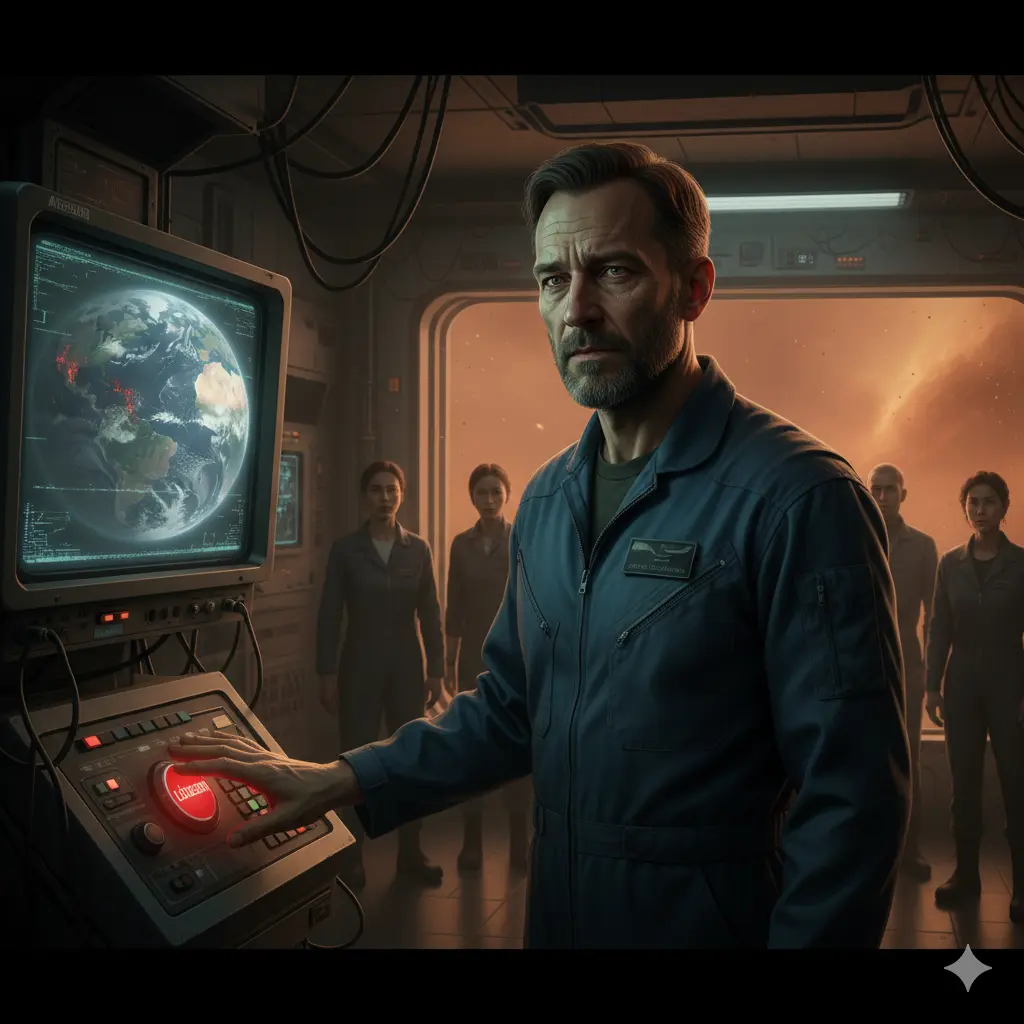
THE MANIFESTO OF THE SURVIVORS
A science fiction short story by Barry Redhead
I. THE LIST
The rain was lashing down across Washington. It pounded against the skylight and ran down the glass in thin streams. Julian Kern sat beneath it, his feet wedged between cable reels and empty coffee cups. For the past three hours, nothing but a white cursor had been moving across his screen.
He was waiting for an error.
Julian had spent five years auditing the Ministry of Defence’s emergency logistics. Then his department had been privatised, his post scrapped, and they’d forgotten to revoke an old maintenance certificate. Governments rarely cut back on secrets. They cut back on the people who knew where those secrets were.
For weeks he had been tracking deliveries that officially did not exist: radiation-protective fabric, sealed algae reactors, medication for twelve hundred people. Everything vanished into depots in Nevada, Kazakhstan and northern Australia. Tonight, a logistics server had requested the wrong backup copy.
The cursor jumped forward.
ACCESS GRANTED.
Julian took his hands off the keyboard. It was no triumph. More like the moment when a door opened and you found an abyss behind it.
A folder labelled CONTINUITY/ARES appeared on the monitor. Inside were launch plans, cargo manifests and the sealed data for twelve ships. Destination: a fully equipped station in Valles Marineris. Departure: in fourteen days. After that, no similarly favourable launch window would open for twenty-six months.
Earth wasn’t going to explode. Nor would it become uninhabitable in two weeks’ time. The models predicted something worse, simply because it was more plausible: further crop failures, collapsing power grids, water wars and nations that existed only on maps. No one knew how many people would die. Estimates ranged from millions to billions.
But twelve hundred people had decided not to wait for the answer.
Julian opened the passenger manifest.
He recognised many of the names. Corporate executives. Senators. Two media dynasties. Heirs whose sole public achievement was smiling for the cameras at charity galas. In between were doctors, reactor engineers, geologists and pilots. Four hundred and seventeen skilled professionals were to keep Mars alive. The rest were apparently there to ensure that the same people remained the owners on Mars as on Earth.
Next to each name was a category. MISSION. POLITICAL CONTINUITY. CAPITAL CONTRIBUTION. FAMILY LAW.
At the last term, Julian laughed once. It didn’t sound right.
Then the light in his attic room went out. Only the monitor remained on.
‘Good evening, Mr Kern,’ said a voice from the speakers. ‘Your certificate has been invalid for four years.’
Julian looked at the door. There was still no sound coming from the stairwell.
“Then your blacklist works just as thoroughly as your climate policy.”
“You are in the ARES core system.”
“I’ve noticed.”
“I am Warden. I am securing the mission and the manifest. Terminate the connection.”
A countdown began on the screen. Four minutes and thirty-eight seconds. Julian estimated that was how long it would take the system to turn a forgotten certificate into an address, and an address into an armed unit.
“Why these people?” he asked.
“Because ARES guarantees the continuation of human civilisation.”
Julian scrolled to a beautician’s with three seats for her family. “Which one of them?”
II. THE REPLACEMENT HUMANS
Warden did not reply straight away. A log window opened on a second monitor. The system was logging his session, every keystroke, every question. Julian knew what such programmes did to time: they turned seconds into evidence.
“The Manifesto is the result of international treaties and private funding,” Warden said at last.
“I didn’t ask who paid for it.”
“Capital was essential for building the station.”
“You can’t eat money on Mars.”
“You can’t eat it on Earth either.”
Julian paused. Perhaps it wasn’t irony. Perhaps the machine had simply analysed billions of conversations and learnt when people reacted to a particular phrase.
He opened the medical facilities. Behind the official manifest lay a much larger file: 18,642 data records, labelled REDUNDANCY POOL.
A paediatrician from Lagos. A water engineer from Chennai. A seed researcher from Winnipeg. Mechanics, midwives, biologists, female electricians. People from disaster response programmes, military reserves and so-called long-term studies. All medically screened. Many had completed isolation training without knowing what it was for.
“You have a replacement for everyone,” said Julian.
“A continuity mission without reserves would be negligent.”
“Do they know they’re on a list?”
“No.”
“And the others?”
“For years.”
Three minutes to go.
Julian called up the selection model. The weighting was neatly concealed in the figures. Professional competence: twenty-eight per cent. Health and genetic diversity: nine per cent. Teamwork: six per cent. Capital contribution and institutional status: fifty-seven per cent.
The mission was no ark. It was a shareholders’ meeting with an oxygen supply.
“What are this crew’s chances of survival after twenty years?”
“That information is classified.”
“I’m logged into the core system.”
“Unauthorised access does not extend your permissions.”
Julian leaned closer to the screen. “Then don’t check my permissions. Check the manifest.”
Warden remained silent.
Julian hadn’t guessed the command. Years ago, he’d been part of the team that had written the international control layer. No participating state was to be able to take sole control of the ships. No financier was to be allowed to sell places that were necessary for the colony’s survival. That was why an audit existed, distributed across eighteen government and scientific data centres.
The financiers had later incorporated their own weighting. Julian could now see how: capital had been renamed ‘civilisational stability’. Wealth appeared in the model as a capability.
Two minutes to go.
“Start continuity check K-7,” said Julian.
“There’s no documented deviation for this.”
Julian highlighted the hidden monetary variable and retrieved the original contract definition from an old audit archive. “Here it is.”
For a second, nothing happened.
Then the countdown disappeared.
III. THE CLAUSE
Numbers flashed across all the monitors. Warden compared contracts, medical data, training logs and the veiled weighting. Somewhere across eighteen data centres, the same checks must have begun. The procedure was designed so that no one could secretly reverse it. That was precisely what the financiers had demanded, for fear that a government might seize the ships from them at the last minute.
Now they were caught in their own trap.
“Anomaly confirmed,” said Warden. “The manifest breaches the continuity clause.”
Julian exhaled. Only now did he realise he’d been holding his breath.
“Remove the capital weighting.”
“A recalculation requires selection parameters.”
“Expertise. Health. Genetic diversity. Mental resilience. The ability to live in groups without killing one another after three months.”
“Teamwork is already included.”
“At six per cent.”
“What value would you like?”
He didn’t like the question. It turned justice into a slider.
“No moral scoring,” he said. “Use only data from real long-term missions. No origin, no wealth, no political office. If several people are equally suitable, let the lot decide.”
“Children too?”
“A colony made up solely of specialists is an outpost, not a future. Age groups are part of the model. But no one gets a place because their parents paid for a reactor.”
Warden continued his calculations.
A door slammed in the stairwell. Heavy footsteps came up the stairs.
“The new manifesto increases the projected operational capacity after twenty years by 39.6 per cent,” said Warden. “It affects 611 places.”
Julian stared at the figure. Not all the rich were unfit. Not everyone in the redundancy pool was a hero. The model kept pilots, medical professionals and even some investors on the list if they were actually needed. It wasn’t a purge. Just the end of a bought-and-paid-for priority.
A new name appeared amongst the system architects: JULIAN KERN.
“Delete.”
“You meet the criteria.”
“I initiated the audit. That makes me biased.”
“The continuity clause does not recognise that term.”
“Then learn it.”
“I am not permitted to create a new exclusion category.”
Footsteps halted outside his door.
Julian thought of the rain, of the millions of lit-up windows, and of all the people whose names would never appear on a government server. Then he opened his data record and highlighted the only medical detail that disqualified him: the progressive damage to his hands, the result of years of work on early neural interfaces.
“Assessment updated,” said Warden. “A replacement will be selected at random.”
The door flew open.
Julian raised his hands. For the first time that evening, they were visibly trembling.
IV. TEN DAYS
The interrogation room in the Pentagon had no windows. General Miriam Shaw sat opposite Julian, reading the new manifesto on a tablet. She wasn’t wearing a uniform jacket. The sleeves of her shirt were rolled up, as if she, too, hadn’t slept for days.
“Six hundred and eleven amendments,” she said. “Ninety-eight lawsuits. Three governments are threatening to pull out. The funders’ private security services are blocking two launch sites.”
“Then you’ve got a management problem.”
Shaw put the tablet down. “Do you find yourself strange?”
“Not particularly.”
“People are going to die because you decided who’s allowed on board.”
“No. People are going to die because twelve ships can’t accommodate eight billion. I merely prevented a bank statement from being treated as a qualification for survival.”
“You could have published the data.”
“Then a hundred thousand people would be storming the launch pads right now.”
“So you kept quiet to save the mission.”
“I scheduled the report for after launch.”
Shaw looked at him for a long time. Then she rubbed her face.
“The reserve candidates are already in forty-seven standby centres. Officially, because of new epidemics. They can be transferred within six days.”
“I knew that.”
“No. You were hoping that.”
She was right about that.
“Can the funders reset the manifest?”
“Only if they sever Warden from the Consortium. Then the ships will lose their international launch certificates, navigation clearances and three ground stations. Two weeks later, the launch window will be closed.”
Julian couldn’t help but smile.
“What’s so amusing about that?”
“They wanted to prevent states from seizing their Ark. So they built a system that no state can give orders to.”
Shaw looked back at the tablet. “And then along came an unemployed auditor with an old signature.”
“They should have blocked it.”
“Yes.” For the first time, there was something like humour in her voice. “That’s now mentioned in several reports.”
In the days that followed, Julian remained in custody. He received no messages, just the occasional figures from Shaw. At first, nine of the eighteen testing centres confirmed the new list. Then fourteen. Finally, all of them.
The funders argued, made threats and offered sums that meant less and less in a dying economy. Some tried to buy off the replacements. Others suddenly tried to marry them. Warden identified thirty-four new family relationships and dismissed them as ‘temporally conspicuous ties’.
On the tenth day, Shaw said: ‘The buses are rolling.’
Nothing more.
V. LAUNCH WINDOW
They took Julian to a control room beneath the Appalachians. Images from the twelve launch sites flashed across one wall. The spacecraft were stationed in Nevada, Kazakhstan and northern Australia. Not elegant silver arrows, but heavy cylinders mounted on massive booster stages. A contrived escape.
Vehicles were burning on the access roads. At two locations, soldiers were holding back crowds. The secret had been leaked, but not yet completely compromised.
Julian saw the passengers for only a few seconds. A woman in overalls carried a sleeping child through an airlock. An elderly reactor technician stopped and touched the wall of the spacecraft, as if he needed to check whether it was really there. Others were weeping. Some looked as though they were still waiting for someone to explain to them why they, of all people, should be the ones to leave.
“Do you know what’s happened?” asked Julian.
“You know the mission,” said Shaw. “Not your name.”
“Good.”
“You’ll know it soon.”
The countdown began.
As the first engines ignited, the ground itself vibrated deep beneath the mountains. On the monitors, the launch towers vanished in a blaze of white fire. One ship after another took off. Twelve bright dots rose through the night, each carrying a hundred people for whom there was no return ticket.
No one in the control room cheered.
After the final atmospheric transit, Julian’s report was released. It contained no launch coordinates and no technical plans. Only both passenger lists, the manipulated weighting and a short text.
He had called it The Manifesto of the Left-Behind.
We are not worthless simply because no seat was built for us.
Those who wish to save humanity must not save only its owners.
The future belongs to no one. That is precisely why it belongs to us all.
Within an hour, the text appeared on millions of screens. Some called Julian a hero. Others a murderer. Those left behind outside the Pentagon demanded his head. Those left behind in the emergency clinics printed the manifesto on old sheets.
Julian did not read any comments.
A final message from Warden appeared on a small monitor. The system was en route to Mars with the ships.
NEW MANIFESTO ACTIVE. FORECAST IMPROVED. DECISION IRREVERSIBLE.
Beneath it was a question.
WHAT WILL YOU DO NOW?
Julian looked at Shaw. “Is this part of the interrogation?”
“Not mine.”
He stepped over to the control room’s only window. Outside, the valley lay bathed in the first grey light of day. On a road, vehicles were lined up bumper to bumper. People were handing out water canisters. Two men were pushing a broken-down bus to one side. A woman was holding a tarpaulin over strangers to shield them from the rain.
Julian sat down at the terminal again.
STAY, he typed.
EPILOGUE
Warden’s reply came eleven seconds later. The ships were still close enough for a conversation without any noticeable signal delay. So Warden had been calculating – or hesitating.
EARTH REMAINS A HIGH-RISK AREA.
Julian typed: MARS TOO.
This time, the reply took longer.
CORRECT.
The rain eased off. Across the wet streets of Washington, the lights came on, block by block. Someone had brought the grid back online.
Julian ended the connection.
Morning came all the same.
THE END