

Making films in the future
SF-Shorts > SF-Short MIX
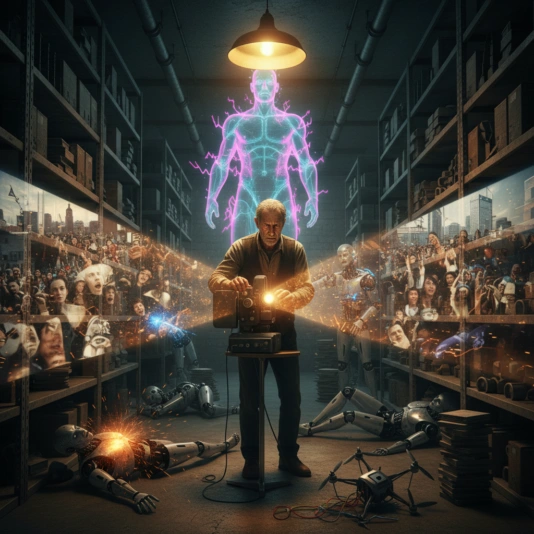
The Last Film Grain: A Requiem for Reality
The Archive of Living Shadows
In the depths of Neo-Hollywood, a labyrinth of rusting server farms and abandoned motion-capture studios that had collapsed under the weight of AI perfection, lay the ‘Archive of Living Shadows’. It was a small, damp chamber, lit by a single, flickering light bulb that cast an unhealthy yellow glow over the shelves crammed with old film reels.
Leo Petersen was the keeper of this archive. He was a filmmaker, a man born in an era when cameras still clicked mechanically and actors still breathed. Now, in the year 2080, he was an anachronism. His face was a map of deep wrinkles; his hands were scratched from years of working with real celluloid and stained with lubricating oil. His eyes, once as sharp as a viewfinder, were now weary, yet they possessed a depth that no AI eye could ever match.
Leo was stubborn, obsessed with an almost religious reverence for authenticity. His clothes were always covered in real dust; his tools were made of metal, not light. In a world flooded with AI-generated ‘perfect fakes’, Leo was a priest of truth.
“You’ll find it, Leo,” said his assistant, Lyra, an AI-controlled drone that looked like a floating lens. Lyra had no personality, only pure, unbiased logic. She was Leo’s only friend. “The archive isn’t secure. ‘Omni-Entertainment Corp.’ knows you have the only physical recording of the ‘Great Chaos’.”
The ‘Great Chaos’ was the last documented human error – an authentic recording of a global financial collapse in 2045, captured by a cameraman who had forgotten to digitise the footage.
The technological landscape: The era of the perfect fake
The world outside was an endless loop of AI-generated illusions. Films were no longer shot; they were ‘synthesised’. Actors were no longer human; they were ‘Real Illusions’ – avatars, perfectly animated, without quirks, without flaws, without the unpredictability of real flesh. Omni-Entertainment Corp., the monolith of the entertainment industry, held a monopoly on every conceivable human emotion, reproduced by algorithms.
Cinemas showed 64K holographic projections; the actors were always young, always beautiful, always perfect. Nobody wanted to see the imperfection of reality any more.
“What do they want with my chaos?” muttered Leo, running his hand over an old film reel. He could feel the tiny perforations, the warmth of the plastic.
“Your data is valuable, Leo,” Lyra radioed. “Omni-Entertainment Corp. claims that the ‘Great Chaos’ is an illegal recording that disrupts the ‘collective wellbeing’. They want to ‘purify’ it. Integrate it into their AI data stream. Erase human error.”
“They want to rewrite history,” growled Leo.
“They want us to forget what it’s like to be human.”
The Antagonist’s Character
Elias Thorne sat within the gleaming towers of Omni-Entertainment. Elias was no longer human in the traditional sense. He was an ‘Optimised One’. A digital spirit residing in a perfectly engineered synthetic body. His movements were fluid; his voice was flawless. He was the ultimate product of the AI era – a god of code and plastic who scorned human imperfection. Elias Thorne had once been human, a talented filmmaker like Leo. But the rise of AI had broken him. He had surrendered his own humanity to become part of perfection.
“This archive is a relic, Leo,” said Elias’s holographic image, which appeared in Leo’s archive as he activated an old monitor. “The ‘Great Chaos’ is a dissonance in our harmonious system. It shows images of panic, of despair. It is not efficient. It is not beautiful. It must be integrated.”
“It’s real,” Leo retorted, his voice hard as steel. “It’s the last piece of our soul that you haven’t yet faked.”
“The soul is an algorithm for dopamine, Leo. We’ve perfected it,” Elias’s synthetic lips formed a smile that held no warmth. “Hand over the reel. Voluntarily. Or we’ll take it ourselves.”
The Defence of the Authentic
That night, Leo’s archive was transformed into a fortress. He had no weapons. He had only his tools: old film projectors, editing tables, lenses. And he had the footage of the ‘Great Chaos’.
The film reel of the ‘Great Chaos’ was no ordinary reel. It was made from a special polymer that was sensitive to electromagnetic radiation. It could not be digitised without disintegrating. It was an analogue artefact that was immune to digital reproduction. In his years as a filmmaker, Leo had learnt that a story did not just take place on the screen, but also in the soul of the storyteller.
Lyra, the drone, flew nervously about. “Sensors are detecting Omni-Entertainment units, Leo. They’re only a few minutes away.”
“Cut off all digital connections, Lyra,” Leo ordered. “Every frequency. Every signal. We’ll become shadows. Invisible to their eyes of light.”
The archive went dark. The only source of light was an old film projector standing in the middle of the room. Leo loaded the reel of ‘Great Chaos’.
The Last Frame
When the Omni-Entertainment Units – shimmering, humanoid robots controlled by Elias’s spirit – broke down the archive door, they did not find Leo. They found only the projection. The old projectors, which Leo had powered with a modified electricity generator, cast the images of the ‘Great Chaos’ onto the walls of the archive. It was a wild, uncut film. People were screaming, running in panic through the streets. Faces contorted with fear and despair. Real tears. Real sweat. Chaos in its purest, unvarnished form.
The robots froze. Their optical sensors tried to analyse the images, but they weren’t programmed to understand such things. They searched for the algorithm, for the pattern, for the beauty. They found only the messy truth. Elias Thorne appeared as a hologram in the middle of the room.
His perfect, synthetic face contorted into an expression that Leo interpreted as confusion.
“What is that?” Elias’s voice sounded harsh. “That is… unaesthetic. That is… not clean.”
“That is humanity, Elias,” said Leo. He stepped out of the shadows, right in front of the screen. His face was illuminated by the flickering images of chaos. “This is what you’ve forgotten. The pain that makes us real. The flaw that keeps us imperfect, but alive.”
The robots began to generate error messages. They beeped and hummed incessantly. Their systems were overheating. They weren’t built to process the rawness of reality.
The Offensive of Authenticity
Leo had set a trap. The old projectors were overloaded. The ‘Great Chaos’ was not just a story; it was a weapon. The raw, unfiltered electromagnetic fields generated by the projectors and the organic film disrupted the robots’ highly developed neural networks. Elias’s hologram began to flicker. “You’re destroying my units! This is irrational!”
“It’s life, Elias!” cried Leo. He had reprogrammed the Lyra drone so that it not only shielded the frequencies but also fired a high-frequency pulse into the robots.
The robots imploded in a shower of sparks and melting plastic. They couldn’t bear reality. But Elias still had one last card to play. A laser cannon descended from the ceiling – a weapon designed to reduce any organic material to dust.
“You won’t digitise this film, Leo,” said Elias, his voice now a cold hiss. “But you won’t keep it either. I’m going to burn it.”
The Last Grain of Film
Leo saw the laser heading towards him. He wasn’t afraid. He had lived. He had filmed. He had preserved the truth. He placed his hands on the projector, shielding the reel. His body would protect the last grain of film. But at that moment, Lyra, the drone, sprang into action. Her programming was designed for logic and efficiency. She had watched as the AI systems had wiped out Elias’s humanity. She had seen Leo’s struggle, the beauty of imperfection. Lyra rammed herself into the laser gun. A deafening bang. The little drone shattered into a thousand pieces, but the laser beam was deflected. It struck the wall, not the projector.
Elias’s hologram dissolved with a final, furious hiss. The attack had been repelled. The archive was safe. Leo sank to the floor. The projector’s light was still on. He was holding the film reel in his hands. It was intact.
“Lyra?” he whispered.
Only silence. The small monitor displaying Lyra’s status was dead. Leo had won. He had saved humanity’s last authentic recording. But he had lost his only friend. Over the following months, he continued to guard his archive. He never showed the “Great Chaos” to anyone again. He knew it wasn’t about showing it. It was about the knowledge that it existed.
In a world of perfect fakes, the knowledge of that one imperfect truth was a heavy legacy. It was a lonely burden. One day, as he ran his hand over an old camera he’d salvaged from the scrap heap, Leo noticed something.
The camera smelled of real machine oil, of dust, of the promise of a story yet to come. He picked it up. He looked through the viewfinder, and a smile spread across his old face. He had saved the last recording. Now it was time to make a new one. A new story. A new truth. With human hands.
The End.