

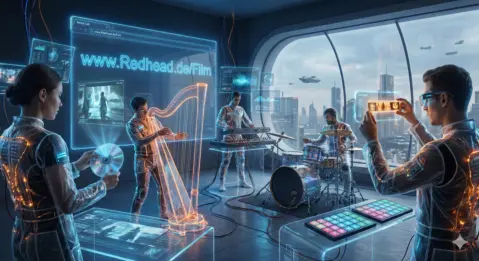
Music make by a AI Computer
Texte
AI and Music: A Symphony of Algorithms or the End of Creativity?
The world of music stands at a crossroads. For a long time, it was a bastion of human emotion, intuition, and untamed creativity. However, with the rapid advancement of Artificial Intelligence (AI), a new player has taken the stage: AI-generated music. Today, algorithms do not just compose simple melodies; they create entire symphonic works, complex jazz improvisations, and catchy pop songs. But what does this mean for the future of music? Is it a revolution or a threat?
The Pros: The Possibilities are Limitless
- Democratization of Music Production: AI can enable people without musical training to compose their own pieces. This fuels creativity on a completely new level.
- Infinite Inspiration: For artists, AI can be a powerful tool for discovering new ideas, chord progressions, or rhythms that they might never have conceived themselves. It becomes a musical sparring partner.
- Personalized Audio Experiences: Imagine soundtracks that adapt dynamically to your mood or background music perfectly tailored to your workout. AI can customize listening experiences like never before.
- Efficiency & Cost Savings: For film and video productions, AI music offers a fast and cost-effective alternative to expensive composers—perfect for niches or budgets that otherwise wouldn't allow for custom music.
- Exploration of New Genres: AI is not bound by human ways of thinking and can therefore create entirely new soundscapes and musical styles that expand our listening habits.
The Cons: Where is the Soul of the Music?
- Authenticity and Emotion: Can an algorithm truly "feel" or "suffer"? AI can imitate human emotions and map them musically, but the real experience behind a love song or a funeral dirge remains exclusive to humans.
- The Value of Art: If music can be generated en masse and for free by machines, how will that affect the value of human art and the livelihoods of musicians and composers?
- Creative Stagnation: Is there a risk that artists will rely too heavily on AI, letting their own creative muscles atrophy? Will we only hear variations of the familiar because algorithms are trained on existing data?
- Legal Gray Areas: Who owns the copyright to a piece generated by an AI? The developer? The user? Or the AI itself? Many questions remain unanswered here.
- The "Perfect" Formula: The fear that AI will reduce music to a mathematically perfect but soulless formula—technically brilliant, but emotionally hollow.
Can AI Generate Music with Real Feeling?
This is the core question. Currently, the answer is a clear "yes and no." AI can recognize patterns, analyze structures, and replicate or recombine them with astonishing precision. It can learn which musical elements trigger specific emotions (e.g., minor chords for sadness, fast tempi for joy). What it cannot do (yet) is have the human experience that creates these emotions in the first place. An algorithm can compose a heartbreaking piano piece, but it has never experienced heartbreak. The music may sound sad, but the sadness is not its sadness. This is the line between simulation and authenticity.
The Future: Coexistence instead of Competition
The most likely future is one of coexistence. AI will not replace the human musician; it will complement them.
- The Composer as Conductor of Algorithms: Artists will use AI to generate ideas, create demos, or simplify complex orchestrations before adding their own final touch.
- New Hybrid Genres: Human intuition meets algorithmic precision, leading to entirely new and fascinating sounds.
- Interactive Music: Live performances where AI reacts to the energy of the audience, adjusting the music in real-time, could become commonplace.
Conclusion: AI music is more than just a gimmick. It is a technological evolution with enormous potential and profound questions. It challenges us to redefine what music is, who creates it, and how we want to experience it. The decision of whether we view this new symphony of algorithms as an enrichment or a threat ultimately lies with us—the listeners and the creators.