Barry Redhead – Hollywood experience and cinematic storytelling
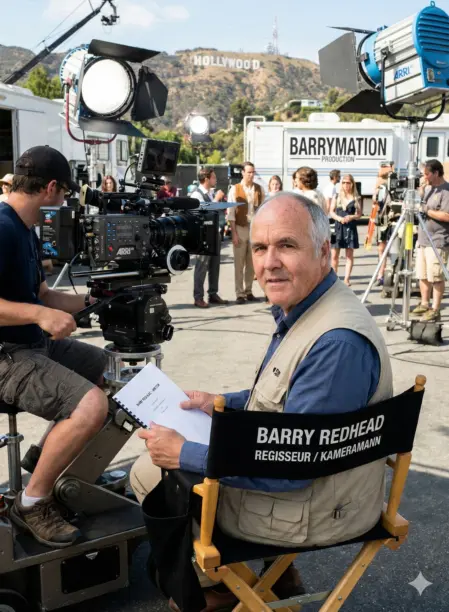
Directing, Camera Work and Cinematic Storytelling
I have been making films since I was ten years old. My first images were captured on real celluloid – first on Normal 8 mm film, later on Super 8. From an early age, I learned not only how to shoot film, but also how to edit it by hand. Hundreds of metres of film passed through my hands, were viewed, cut, assembled, shortened and rearranged. That analogue education still shapes the way I look at images, rhythm and cinematic storytelling today. In the early 2000s, I professionalised my work as a filmmaker in Hollywood. There, I worked as a director, cinematographer and editor with 16 mm and 35 mm celluloid as well as with digital film material. For me, the transition from classic film to digital production was not a break, but a fluid process. While I was still shooting on Super 8, I was already working with VHS, Hi8, Digital 8 and, later, digital workflows. At the time, we edited digital material on Apple computers using Final Cut Pro; today, I mainly use DaVinci Resolve Studio.
Directing remains one of my great passions. I am interested not only in what happens in front of the camera, but also in how a scene actually works through the lens.
That is why looking through the camera viewfinder is, for me, part of the director’s work. Not because I mistrust cinematographers, but because I like to check my own staging directly and visually: Do the framing, perspective, movement, light and atmosphere correspond to what I have set up as the director? After returning from Hollywood to Hamburg, I produced corporate films for small businesses and worked in my studio in Billbrook, where I also spent time using a Steenbeck editing table for 16 mm film. Although celluloid has now largely been replaced by digital formats, the experience of working with real film remains an important part of my artistic foundation.
This combination of directing, camera work, editing and narrative thinking also shapes my work as an author. My stories do not emerge from words alone, but from images, scenes, movement and atmosphere. Especially in my science fiction projects, screenplay ideas and visually conceived stories, I often think like a director: I see spaces, characters, light, perspectives and dramatic moments before they appear on the page. My ambition as an author and screenwriter is to create stories that work both as literature and as cinema – stories that can be read, but also carry the potential for film, series, animation and visual worlds. For me, directing, camera work and writing are therefore not separate disciplines, but different ways of making a story visible.
I remain open to new film projects – whether in the independent sector, for smaller productions, corporate films, audiovisual concepts or television and commissioned work. What matters to me is a compelling subject, a strong visual idea and the opportunity to contribute my experience as a director, cinematographer, editor and writer in a creative way.