
Preserving film continuity.
Film Txt
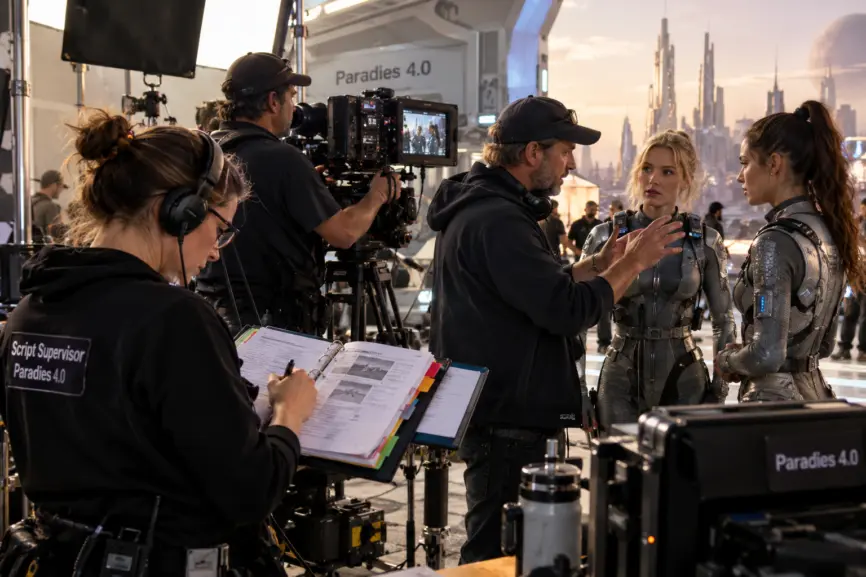
The Script Girl
The Forgotten Film Profession That Never Really Disappeared
From silent cinema to digital filmmaking: how the script girl became the modern script supervisor – and why the job remains essential.
By Barry Redhead – Filmmaker, Director and Author-31 October 2026
An actress walks into a room carrying a cup of coffee in her right hand. The camera rolls. The director likes the performance. Cut. Later that afternoon, the same action is filmed from another angle. This time, the actress holds the cup in her left hand. Nobody notices. The director is concentrating on the performance. The cinematographer is watching the lighting. The camera operator is checking the composition. Everyone has something rather more important to worry about than a cup of coffee. Except one person. “Sorry, but the cup was in her right hand.” Decades ago, that person might have been called the script girl. Today, the professional title is script supervisor.
The change in terminology tells us something about the history of cinema. But the importance of the job tells us something even more interesting about filmmaking itself. A film is not usually shot in the order in which an audience eventually watches it. Scenes are filmed according to locations, schedules, cast availability and production requirements. The finished story must somehow emerge from all those disconnected pieces. And someone has to make sure they fit together.
What was a script girl?
A script girl was a film crew member responsible for monitoring continuity during production. The term was historically used for women who recorded dialogue, actions, camera details and other information needed to ensure that separately filmed shots could be edited into a coherent sequence. The role is now generally known as script supervisor, although the terms continuity and script continuity are still encountered in the industry. A modern script supervisor does much more than notice whether an actor is wearing the wrong jacket. The job involves understanding the screenplay, tracking the chronology of the story, monitoring performances and technical details, recording what has actually been filmed, and helping the director ensure that the material will work in the edit. In many respects, the script supervisor represents the needs of the editing room while the film is still being shot.
The early years: when cinema became complicated
Early cinema was a comparatively simple affair. During the late nineteenth century and the first years of the twentieth, many films were short and consisted of relatively few shots. As filmmaking developed into a major industry, productions became longer and more ambitious. Stories moved between different locations and time periods. Scenes were broken into several camera angles. Shooting schedules became increasingly complex. By the 1910s, American film studios were developing detailed continuity scripts to organise production. These documents provided instructions about scenes, action, filming requirements and the structure of the intended film. But planning a shot and actually filming it are two different things. A character might leave a room in one shot, while the matching shot of the corridor is filmed several days later. The actor's clothing, direction of movement and physical behaviour must still make sense when the two pieces are joined together. As the industry became more sophisticated, the need to observe and document these details grew. Continuity became an essential part of professional filmmaking.
Hollywood's overlooked women
During much of cinema's early and classical history, continuity work was strongly associated with women. The titles script girl and continuity girl reflected an industry in which women were often offered certain specialised and organisational jobs but were not always given the professional recognition their responsibilities deserved. The word “girl” could be applied to an experienced professional carrying considerable responsibility. Today, it sounds strikingly inadequate. One remarkable figure was Angela Allen, the British script supervisor whose career included John Huston's The African Queen (1951). In an interview published by BAFTA, Allen recalled disagreeing with Katharine Hepburn over what the actress had worn in an earlier shot. Allen stood her ground. Huston supported her judgement. The incident illustrates an important aspect of the profession: continuity is not merely a matter of taking notes. It requires confidence, technical understanding, extraordinary powers of observation and the diplomacy to challenge people who may be considerably more famous than the person holding the script.
The problem with filming a story out of order
Imagine a crime thriller. In the finished film, a detective enters an office, confronts a suspect, suffers an injury and leaves the building. The whole sequence lasts only a few minutes. On set, however, the detective's departure might be filmed on Monday, the confrontation on Wednesday and the arrival on Friday. Each scene must still belong to the same fictional timeline. Which hand was injured? Was the detective carrying a briefcase? Had he taken off his coat? What did he already know about the suspect? Now consider the emotional details. Before the confrontation, the detective is calm and confident. Afterwards, he is frightened, angry and suspicious.
Those changes must remain convincing even when the actor is performing the scenes in reverse order.
Continuity is not simply about matching physical objects. It is about maintaining the credibility of the story and its characters.
What does a script supervisor actually do?
The work begins before a camera is switched on.
Before filming
The script supervisor analyses the screenplay, works out the chronology of the story, identifies potential contradictions and prepares continuity breakdowns.
They consider costumes, props, story days, scene durations and any information that could affect how one shot connects to another.
These records help several production departments prepare for filming.
During filming
The script supervisor monitors a wide range of details, including:
- Dialogue, changes to lines and omitted sections.
- Actors' movements, positions and eyelines.
- Screen direction and camera-axis continuity.
- Costumes, hairstyles, make-up and props.
- Scene numbers, shots and takes.
- Relevant camera settings and technical information.
- The duration of scenes and the coverage needed for editing.
They also maintain records of what has been filmed and whether the director has the material required to assemble the scene. When a potential continuity problem appears, the script supervisor advises the director or relevant department. The director retains responsibility for the final creative decision.
After each shooting day
The script supervisor's notes and reports help the production and editorial teams understand what was recorded. Which take did the director prefer? Was a line altered? Was a shot abandoned? Is the necessary coverage available?
Without accurate information, an editor may have to spend valuable time reconstructing decisions that were made on set. This is why the role is far closer to the creative and technical centre of filmmaking than the old phrase script girl suggests.
Why did the term “script girl” disappear?
The expression belongs to a period when jobs were frequently described according to the gender of the people expected to perform them. It does not adequately convey the authority, expertise or breadth of the modern profession. Script supervisor is a more accurate and gender-neutral title. The change happened gradually, and terminology has differed between countries and production traditions. In British filmmaking, continuity remained a familiar professional description for many years and is still understood today. Germany offers a particularly clear example of formal change: in February 2017, the relevant professional group within the Bundesverband Regie officially adopted Script Supervisor in place of Continuity. The profession did not suddenly become different overnight. Rather, its title gradually came to reflect the complexity of responsibilities that experienced continuity professionals had been performing for decades.
From handwritten notes to digital filmmaking
For much of cinema history, script supervisors relied on handwritten records, annotated screenplays, sketches and photographs. The British Film Institute preserves a particularly revealing example: the continuity script used by Penny Eyles for Sally Potter's Orlando (1992). Filled with notes, drawings and Polaroid photographs, it demonstrates how much information a script supervisor had to manage long before today's digital production tools. Modern crews may use tablets, digital continuity photographs, electronic scripts and dedicated production software. These tools are useful. They make information easier to record, organise and share. But they do not eliminate the need to understand what the information actually means. Knowing that two shots are visually different is one thing. Knowing whether the difference matters to the story is another.
Why the profession remains essential in the age of digital cinema
Modern filmmaking has become technically more sophisticated, not necessarily simpler. Multi-camera shoots, complex visual effects, digital environments, pick-up shots and fragmented shooting schedules all create continuity challenges. Consider a science-fiction film in which an actor stands against a green screen, looking towards a spacecraft that does not yet exist. The spacecraft may be added months later. The actor's eyeline, position and movement must correspond with the eventual visual effect. The sequence must also remain consistent with the fictional geography of the scene. The same principle applies to elaborate action films, psychological thrillers and television dramas featuring complicated timelines. A continuity problem may concern a missing prop. It may also concern information that a character knows before they could possibly have discovered it. The latter can be far more damaging to a story than a disappearing coffee cup.
Could artificial intelligence replace the script supervisor?
Artificial intelligence may eventually become useful in supporting certain continuity tasks. Image comparison, production-data analysis and automated record management are plausible applications. Yet identifying visual differences is only part of the problem. An actor might deliberately change a gesture because it produces a more convincing performance. A minor mismatch might be acceptable if it allows the editor to preserve an emotionally powerful moment. A script supervisor needs to understand the director's intentions, the dramatic meaning of the scene and the consequences for the final edit. These are matters of interpretation and judgement, not simply data matching.
AI may become a valuable assistant. It does not follow that it can replace the experience and collaborative intelligence of a skilled film professional.
The invisible art of keeping a film together
The best continuity work is rarely noticed by the audience. If the film is successful, we do not think about which hand holds a glass, whether a character crossed the screen in the same direction or how many different days were required to film a conversation. We simply believe the story. Poor continuity, however, can break that illusion. A character reacts to information they have not yet received. An action changes unexpectedly between cuts. An important line is missing from the material available to the editor. Suddenly, the audience becomes aware of the machinery behind the film. The script supervisor helps prevent that machinery from becoming visible.
Conclusion: the title changed, but the profession endured
The script girl belongs to cinema history. The script supervisor belongs firmly to its present and future. From the silent era to digital productions and elaborate visual effects, the central challenge has remained remarkably consistent: films are created in fragments, but audiences expect to experience a coherent world. Technology can make the process faster and the records more detailed. It cannot, by itself, guarantee a believable story. Perhaps that is the most interesting aspect of this frequently overlooked profession. Its greatest achievement is often something the audience never notices.
Frequently Asked Questions
What is the difference between a script girl and a script supervisor?
Script girl is a historical, gender-specific term. Script supervisor is the modern professional title for the role responsible for continuity, detailed production records and supporting the editing process.
Is a script supervisor the same as a screenwriter?
No. A screenwriter writes or develops the screenplay. A script supervisor works with the production team to monitor continuity, dialogue and the practical filming of the script.
Do digital films still need script supervisors?
Yes. Digital technology assists with recording and managing information, but narrative continuity, performance consistency and editorial judgement remain essential.
Why is the term script girl no longer commonly used?
It is gender-specific and does not adequately describe the professional responsibilities involved. The title script supervisor is more inclusive and accurate.
About the Author
Barry Redhead is a filmmaker, director and science-fiction author whose creative work explores visual storytelling, film editing, artificial intelligence and the relationship between technology and human experience. Through REDHEAD FUTURE FICTION, he brings cinematic storytelling together with speculative fiction, thrillers and visions of the future.