
B- Movies
Film Txt
Anatomy of Low-Budget Cinema: Where the B-Movie Begins and the Illusion Ends
When the screen flickers in modern home cinemas or on streaming platforms, it quickly becomes apparent how to recognise a genuine classic B-movie: it is not merely about the palpable lack of a multi-million-dollar budget. It is a state suspended between irrepressible cinematic will to survive and economic bankruptcy.
For cinephiles, filmmakers, and writers, the B-movie is a fascinating biotope. Yet where exactly does the boundary lie between an ambitious independent film and a pure B-movie? And what dramaturgical tricks do directors use to disguise an empty purse?
- The Hard Economics: At What Point Is a Film a B-Movie?
In Hollywood's modern star system, the definition has become fluid, yet at its core, venture capital and the distribution model determine the classification.
The Independent Film: Often emerges completely independently of major film studios, financed via foundations, crowdfunding, private investors, or pre-sales. It has no fixed budget cap—an indie drama can cost 50,000 euros, while an indie sci-fi thriller like Moon can cost 5 million dollars. The decisive characteristic is creative independence from studio-internal test screenings and conformist uniformity.
The B-Movie: Is a pure product of B-side exploitation (formerly in double features, today in the direct-to-streaming market). It has a precisely calculated, usually very tight fixed budget (frequently between 500,000 and 3 million dollars), where investors know before shooting even begins that they will not win an Oscar, but instead must recoup their outlay with a minimal profit via worldwide licensing sales. - The Classic Symptoms: How to Spot a B-Movie
Anyone who has studied genre cinema over decades immediately recognises the technical and budgetary emergency seams. The aesthetics of the B-movie follow their own distinct grammar of concealment.
Poor Visual Effects (FX): Where blockbusters boast render farms, B-productions often fall back on inexpensive CGI studios or outdated software. The result is explosions that look like late-2000s video games, or monsters whose textures betray their digital origins in harsh backlighting.
The Unpolished Cast: Unknown actors are both a curse and a blessing. Occasionally one discovers rough diamonds here; more frequently, however, one sees performers whose acting oscillates between painfully stiff and unrestrained overacting. Rehearsal time was too short; the take had to work because daylight was fading.
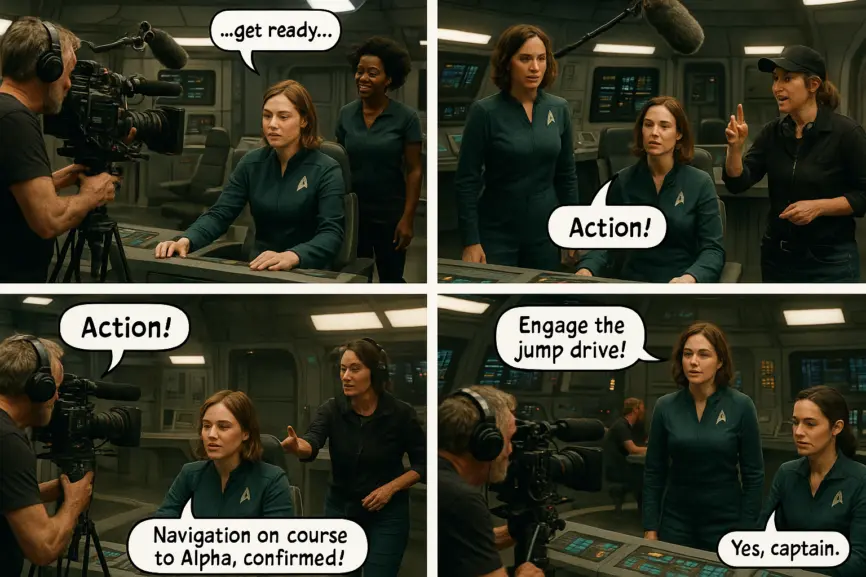
The Art of Concealment – Dialogue Scenes and Close-Ups: Particularly in the disaster and science fiction genres, budget dictates strike mercilessly. When the Earth is ending or an alien invasion is taking place, one sees astonishingly little of it in a classic B-movie. Instead, long, static dialogue scenes in cramped spaces (offices, bunkers, car interiors) and extreme close-ups dominate. The reason is simple: anyone filling the frame with an actor's face does not have to light or digitally extend the expensive, non-existent set in the background. The threat is talked into existence rather than shown.
Conclusion: Honest Sweat Instead of Slick Calculation
The independent film strives for artistic substance and deliberately breaks with conventions. The B-movie, by contrast, is pure craft—often rushed, often naive, yet honest in the best sense. It reveals the naked struggle for survival of a film crew attempting to tell a big story with minimal resources.
The independent film strives for artistic substance and deliberately breaks with conventions. The B-movie, by contrast, is pure craft—often rushed, often naive, yet honest in the best sense. It reveals the naked struggle for survival of a film crew attempting to tell a big story with minimal resources.
At the end of the day, filmmaking craft also means: when you have no money, you have to get inventive.